

Realism vs. Fun: How Much Detail Should a Simulator Game Include?
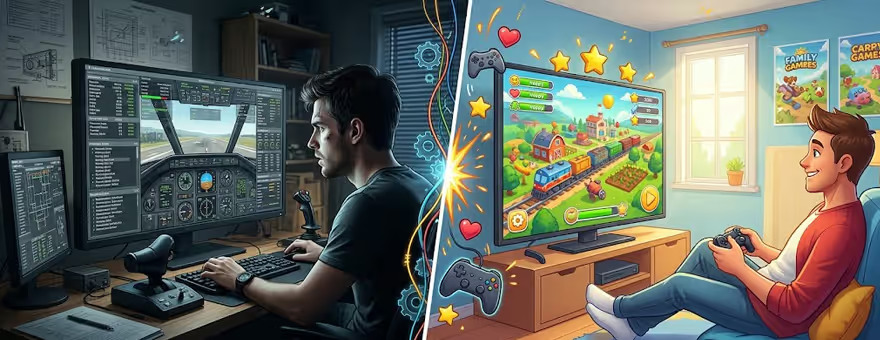
There's a strange moment that happens when we're playing simulator games.
We spend twenty minutes carefully reversing a truck into a parking space, checking our mirrors, adjusting the steering, and trying not to destroy somebody's fence. Finally, we park perfectly. And somehow, we're delighted.
Now, amongst all this driving, which we can easily deem as realism, you’d have to actually fill out some sort of paperwork, wait around the factory so the logistics team can unload the truck, or anything else. You know what we mean, right?
That’s where realism starts getting too real and fun totally fades away. Nobody wants that. Nobody wants to wake up, live, and then come back home to their gaming setup to LIVE again.
So, there has to be a fine line between fun and realism, right? We sure do want games to feel realistic, but we don’t want them to suck the fun out with too much realism.
Realism makes the achievements feel earned
Now, what’s that one value that eclipses any other gaming experience in simulator games? The sense of achievement. You sure do get it in other games as well, but imagine completing THAT task in a simulator. The happiness is off the roof.
Landing a plane becomes exciting because we've learned how to approach the runway properly. Driving a truck through narrow streets feels rewarding because the vehicle actually handles as if it were several tons.
The difficulty gives our achievements weight. If every aircraft landed automatically and every truck handled like a sports car, we'd probably get bored rather quickly.
But nobody wants to simulate boredom
Now here’s another scenario. You’re playing a farming simulator, and the crops are going to take the actual real-life growing time to grow. Yeah. Screw that, right?
Good simulators understand that time needs adjusting. They accelerate boring processes, simplify repetitive chores, and skip the parts that would make players wonder why they aren't just doing the activity in real life.
The little details are surprisingly important
Sometimes the smallest features make the biggest difference. Engine sounds changing under pressure. Mud collecting on tractor wheels. The satisfying clunk of a train door closing.
These things won't really change the objective, but the experience just feels more lively and real.
We're not constantly thinking about them, but we'd notice if they disappeared. They're the little touches that convince our brains we're operating something real rather than pushing buttons on a screen.
More buttons don't automatically mean more fun
There's a certain type of simulator that seems determined to give every keyboard key a responsibility.
Want to start the engine? Excellent. First, locate seventeen switches, consult three manuals, and remember a procedure that apparently requires an aviation degree.
Now there are players who might like that, but there are also players who delete the game straight away.
Neither group is wrong. The trick is giving players choices. Optional assists, adjustable difficulty, and simplified controls let beginners enjoy the experience while enthusiasts dig into the complicated stuff. After all, accessibility doesn't make a simulator less authentic.
Sometimes unrealistic things improve the experience
Here's where things get interesting.
Some of the most enjoyable simulator features aren't particularly realistic. Instant repairs. Fast travel. Convenient camera angles. Being able to restart a disastrous landing without explaining anything to the authorities.
These features would be ridiculous in real life. In games, they're wonderful. They remove unnecessary frustration while preserving the interesting challenges.